How it works
Two sides, only one needs an account
You build the hunt from a computer. Your players open a link on their phone. Here is the whole thing, from the empty map to the final screen.
You, the organiser
Draw the playing field
Pick the area on the map, whether that is a park, a campsite or an estate. You can swap the map for your own georeferenced image if the place has no streets.
Place the objects
Tap the map where each object will be hidden, and choose what it is: something to collect, a riddle step, or a timed treasure visible to everyone at once.
Print and hide
Print the A4 sheet of labels: each one carries its object’s name, so you know what you are about to hide. Cut, tape, go and place them.
Build the teams
Create the teams and their players, then send each one a link. Or play everyone for themselves: each player becomes their own team and the scoreboard is individual.
Rehearse
Launch a test game: same sequence, short clock, and it never consumes a real launch. This is where you find out that a riddle is unsolvable.
Launch and run it
The console shows the scoreboard and what has been found. You push an announcement, drop a treasure, or move an object a dog carried off.
Them, the players
Four moves, nothing to prepare. The longest part is splitting into teams.
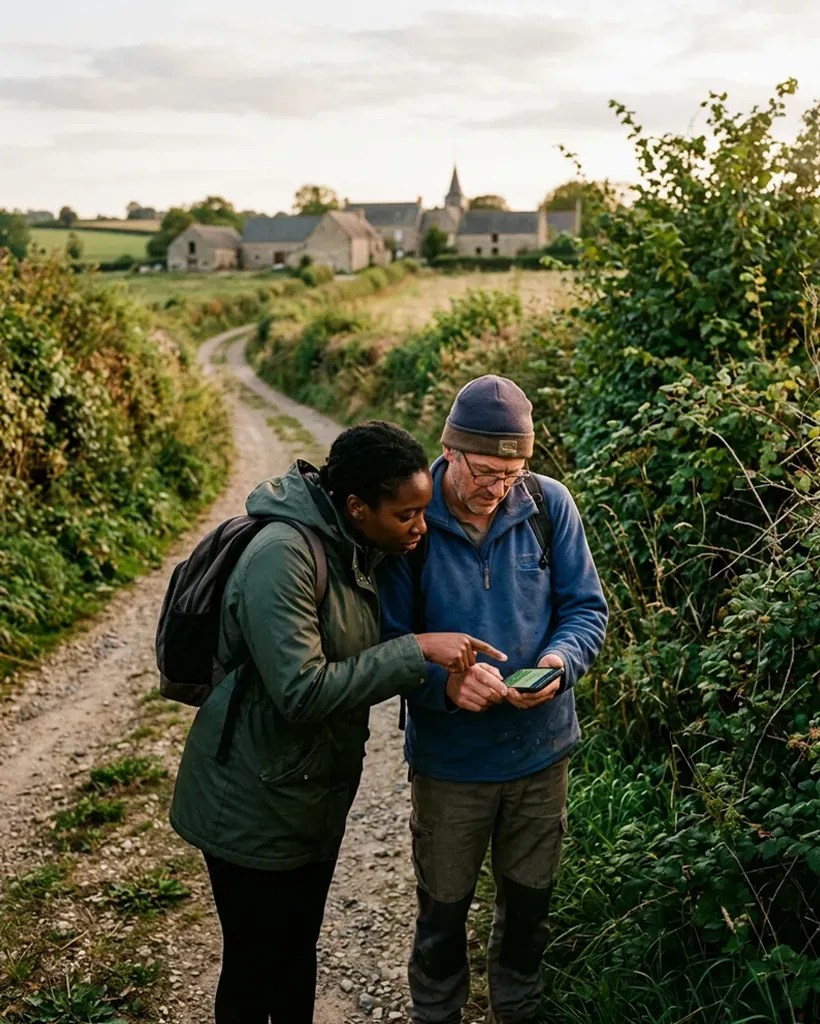
Open the link, or type the code
No app to install, no account to create. A six-character party code works from the hunt address, and it is the one you end up shouting across the car park when somebody has lost their link.
Allow location, or not
The game asks before it collects anything. Location makes the radar work; refusing it locks nobody out, because finding the object is what scores.
Follow the radar
It warms up as the team gets closer, through the screen, the sound and the vibration at once. It never gives a direction or a distance, because it works like warm-and-cold rather than like an arrow.
Scan what you find
Point the camera at the label, or type the five characters printed next to it. Scanning the same object twice costs nothing: it simply says it is already yours.
The field does not obey, and the game knows it
A dog runs off with an object, rain peels a sticker, GPS drifts twenty metres under the trees, the network dies at the far end of the park. None of that ends a hunt.
Temperamental camera
Every label also carries a five-character code that can be typed by hand. No I, no O, no 0, no 1: those four stop being legible on a wet sticker.
No network
What has already loaded stays available, and a capture made offline sends itself as soon as the signal comes back.
A game going sideways
You edit mid-run: move an object, rewrite a riddle, freeze a team. The phones update without anyone reloading.